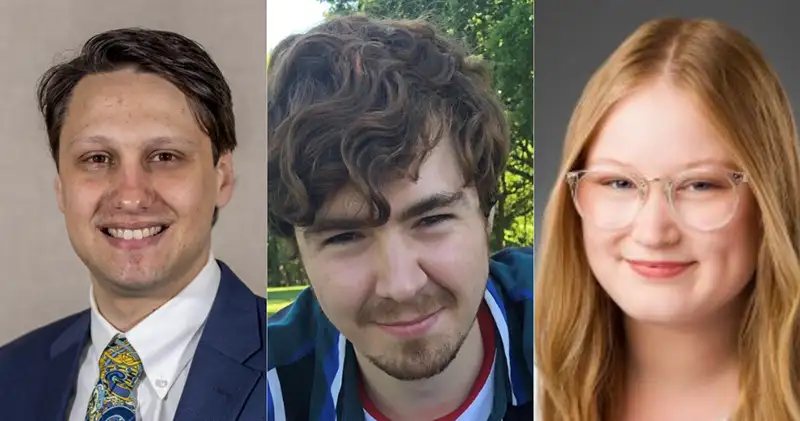
Speakers:
- Samuel Salemink-Harry, Postdoctoral Researcher, Civil and Environmental Engineering Department, UW–Madison
- Benjamin Smith, Postdoctoral Researcher, Mechanical Engineering, Atmospheric and Oceanic Studies, UW–Madison
- Martina Rogers, PhD Candidate, Chemistry, UW–Madison
Freshwater lakes are of great environmental, economic, and recreational importance. These ecosystems are extremely complex, where biology interacts with chemistry and physics, and vice versa. Due to this intricate entanglement, modeling and measuring biophysical processes in lakes remains challenging. The “Making Waves” team brought together experts from various disciplines to investigate how physical processes affect winter mixing, light attenuation, and lake spray aerosol composition. Their broader goal is to understand key physical mechanisms that impact harmful algal blooms, with many questions centered around water waves.
This talk will cover three topics. Smith discusses how the composition of the ice cover influences light availability and mixing underneath ice-covered lakes in winter. Salemink-Harry discusses how water wave motions influence light availability near the water surface. Rogers discusses how wave breaking in lakes can transfer cyanobacteria and microplastics into the atmosphere.